In Part 1 I shared the idea, and in Part 2 I built an 18-hole browser game. Part 2 ended with “next, courses in space and on other planets.” So this time I actually built a golf hole on the Moon.
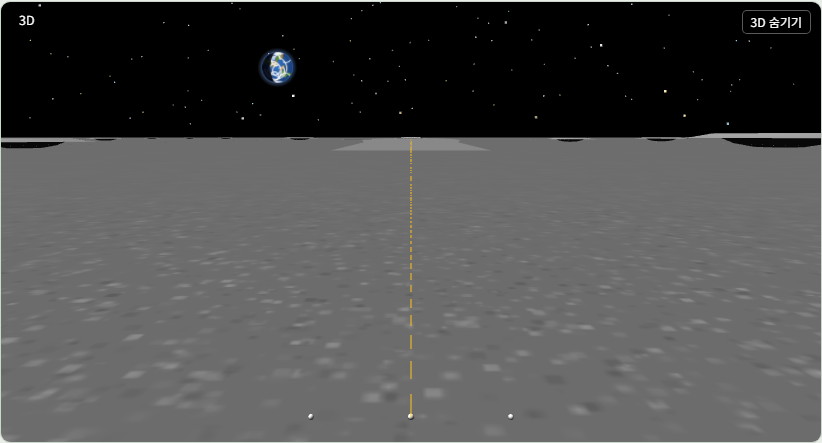
Physics first, scenery second
My first plan was to drop Moon video into the background. But a fixed video falls apart as soon as the ball flies off in a different direction. So I flipped the order: change the physics first, then draw the scenery in 3D.
The Moon has about one-sixth of Earth’s gravity (1.62 m/s²) and no air. No air means no wind, and no hook or slice in flight. I asked Claude Code to change just those two things.
A 1.7 km drive
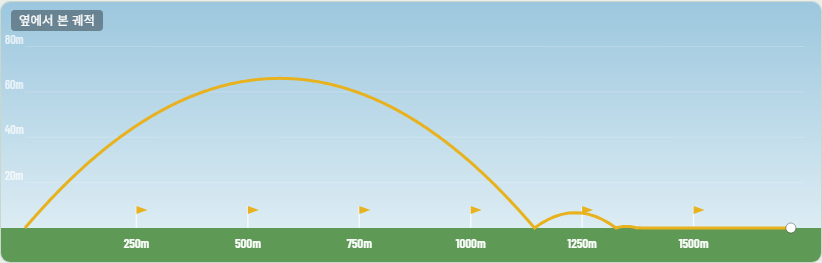
I hit the same drive as in Part 2: 65 m/s ball speed (about 145 mph), 13° launch, 2,700 rpm of backspin.
| Stat | Earth | Moon |
|---|---|---|
| Carry | 212.9 m (233 yd) | 1,143.2 m (1,250 yd) |
| Total distance | 242.8 m (266 yd) | 1,718.4 m (1,879 yd) |
| Hang time | 6.0 s | 18.1 s |
Same swing, more than five times the carry. With the ball in the air for 18 seconds, the game now fast-forwards long flights, with a “real speed” option if you want to watch the whole thing.
Every shot was out of bounds
The first problem showed up right away. With Moon physics on the Earth course, almost every shot went OB. Even the sand wedge flew hundreds of meters.
So I built a dedicated Moon hole: a 2,202 m par 4, designed so a driver plus a sand wedge reaches the green. It started at 2,292 m, but the wedge kept landing 20 m short, so I moved the green and pin 90 m closer.
Backspin still works on the Moon
In testing, a 9,500 rpm wedge rolled 56 m after landing. Without air the ball won’t curve in flight, but spin should still grab the ground when it lands. After that fix, the same shot stopped right where it landed.
- Sand wedge (30 m/s, 30°, 9,500 rpm): 481.1 m carry, 481.1 m total
- Peak height 69.4 m, hang time 18.5 s
A wedge that flies 481 m and stops dead is something you will never see on Earth.

2,000 stars and the Earth
With the physics in place, I added the scenery: about 2,000 stars in a black sky, Earth above the horizon, gray dusty ground and 18 craters. The craters sit outside the OB lines, so they don’t affect play. Earth is drawn about twice its real apparent size, because at true size it looked tiny on screen.
The six-putt mystery
My first Moon round was a birdie: driver, wedge, and a 48 m putt that dropped. The very next round, I six-putted.
I asked Claude Code to explain the cause before fixing anything. The tests showed:
- On a flat green, the ball rolled within 2 cm of the putt distance I entered.
- Slopes worked in the same proportion as on Earth.
- Two bugs turned up. A 40-second calculation limit stopped a 100 m Moon putt at 99.3 m. The real culprit was the second one: putting from off the green (fairway or rough) rolled only a fraction of the distance entered. Enter 13 m, and the ball went 2.2 m.
Once a long putt ran off the green, every putt after that came up short. Now the ball rolls the distance you enter even from off the green, and the screen shows a note such as “includes 3.0 m off the green.” Every putt also logs the distance entered, the distance rolled, and the distance left to the pin.

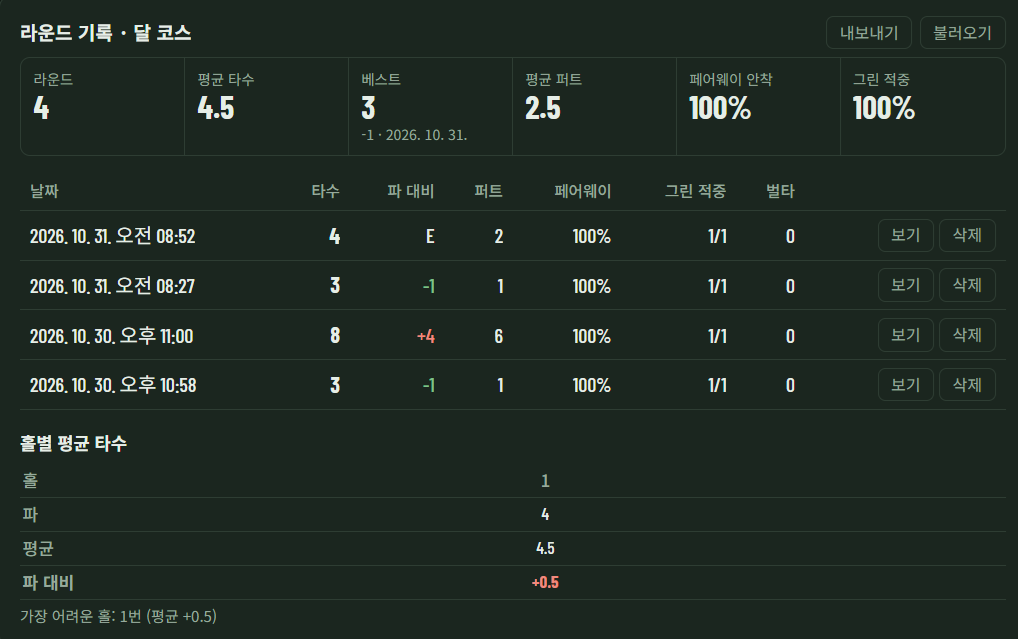
My Moon rounds so far
| Round | Score | Putts |
|---|---|---|
| 1 | 3 (birdie) | 1 |
| 2 | 8 (+4) | 6 |
| 3 | 3 (birdie) | 1 |
| 4 | 4 (par) | 2 |
Try it yourself
The Moon course is live in your browser now. Open it on a desktop or laptop, then under Planet on the left, pick Moon. Use the English and yd buttons at the top right to switch to English and yards.
Suggested shots: driver (65 m/s, 13°, 2,700 rpm), then sand wedge (30 m/s, 30°, 9,500 rpm).
What I learned
- Ask for the cause first. Saying “explain the cause before you fix it” instead of “fix it” led straight to the real bug.
- Logs make debugging easy. As soon as putts were logged, it was obvious where the strokes went.
- Physics first, scenery later. The scenery only feels real once the ball flies believably.
What’s next
On the Moon, the gaps between clubs are huge (sand wedge about 481 m, pitching wedge about 768 m). Next I’ll add partial swings, and then Mars. I’m curious how a ball flies on a red planet with only 1% of Earth’s air.