Here is the short version: on Mars, a driver carries over 500 m and rolls out to 750 m, and you can birdie a 1,050 m par 4. I added a Mars course to my browser screen golf game and played two rounds on it today.
In Part 3, the game got one hole on the Moon to go with its 18 holes on Earth. The whole point of this project is to play golf in places I could never actually go. After the Moon, Mars was the obvious next stop.
As before, I did not write the code myself. I described what I wanted to Claude Code and checked the results. My job was to be precise about the goal and careful about testing.
Mars physics: what changed
Changing just two things, gravity and air, turns golf into a different game.
| Setting | Earth | Mars |
|---|---|---|
| Gravity | 9.81 m/s² | 3.71 m/s² (about 38% of Earth) |
| Air density | 100% | 1.6% of Earth |
| Wind effect on the ball | Large | Almost none |
With almost no air, there is almost no drag holding the ball back and almost no lift holding it up. Low gravity keeps the ball in the air for a long time instead. Even a 6 m/s wind barely changes the distance.
The hardest decision was what happens after landing. Without air, backspin no longer lifts the ball, but friction at impact is still there. So I made the remaining backspin grip the ground when the ball lands.
The result: a low-spin driver lands and runs a long way, while a high-spin wedge stops almost where it lands. I set the targets at 750 m total for the driver and 300 m carry for the pitching wedge.
Designing a 1,050 m par 4
Hole 1 on Mars is a 1,050 m (1,148 yd) par 4. I worked backward from the flight numbers: a 750 m drive leaves exactly 300 m, one full pitching wedge.
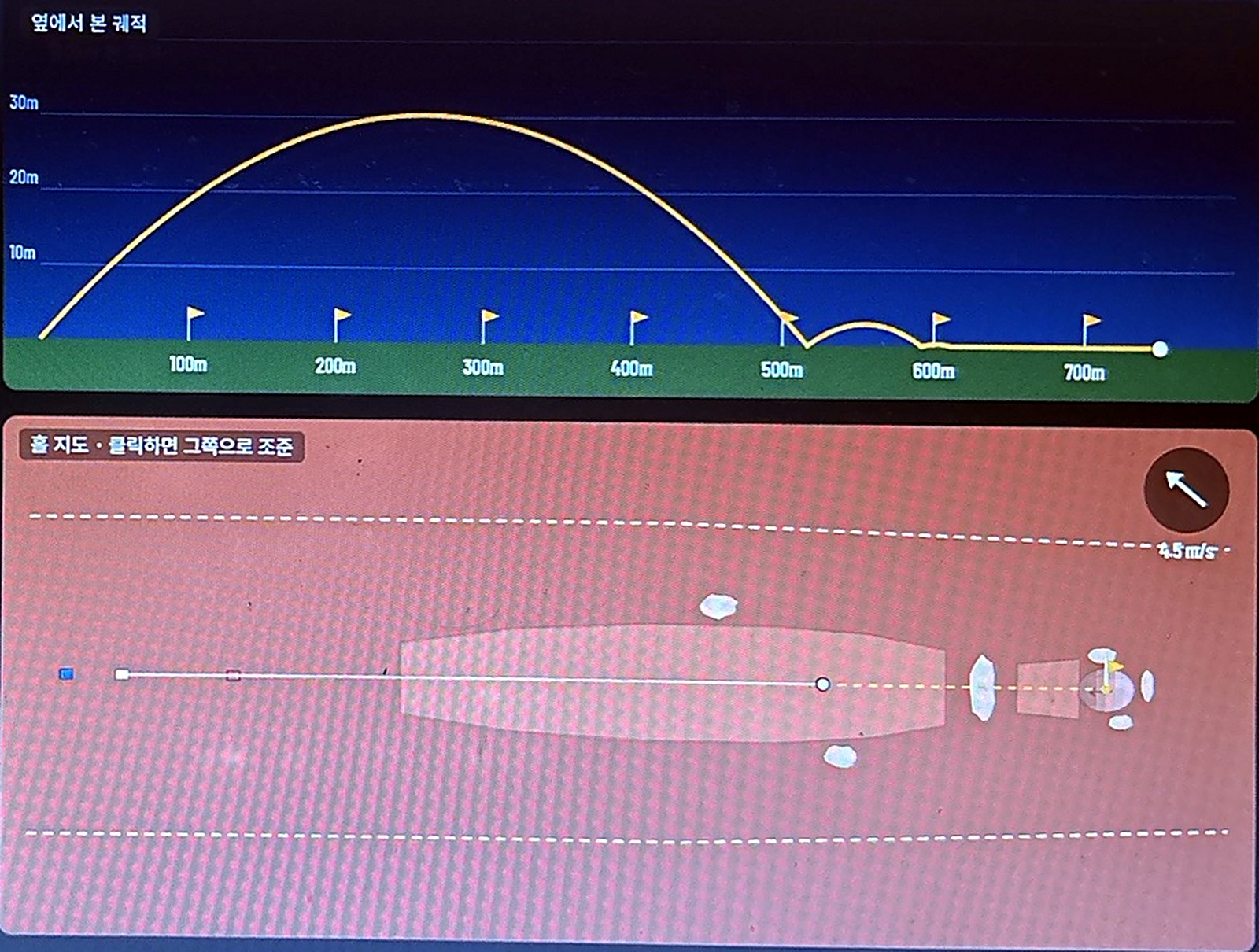
- Tee to fairway: the fairway starts around 520 m, where drives land, and runs to about 750 m.
- Hazards: red sand bunkers flank the fairway and guard the front and back of the green.
- Green: a 1.2% slope with one mound and one hollow, so you have to read the putt.
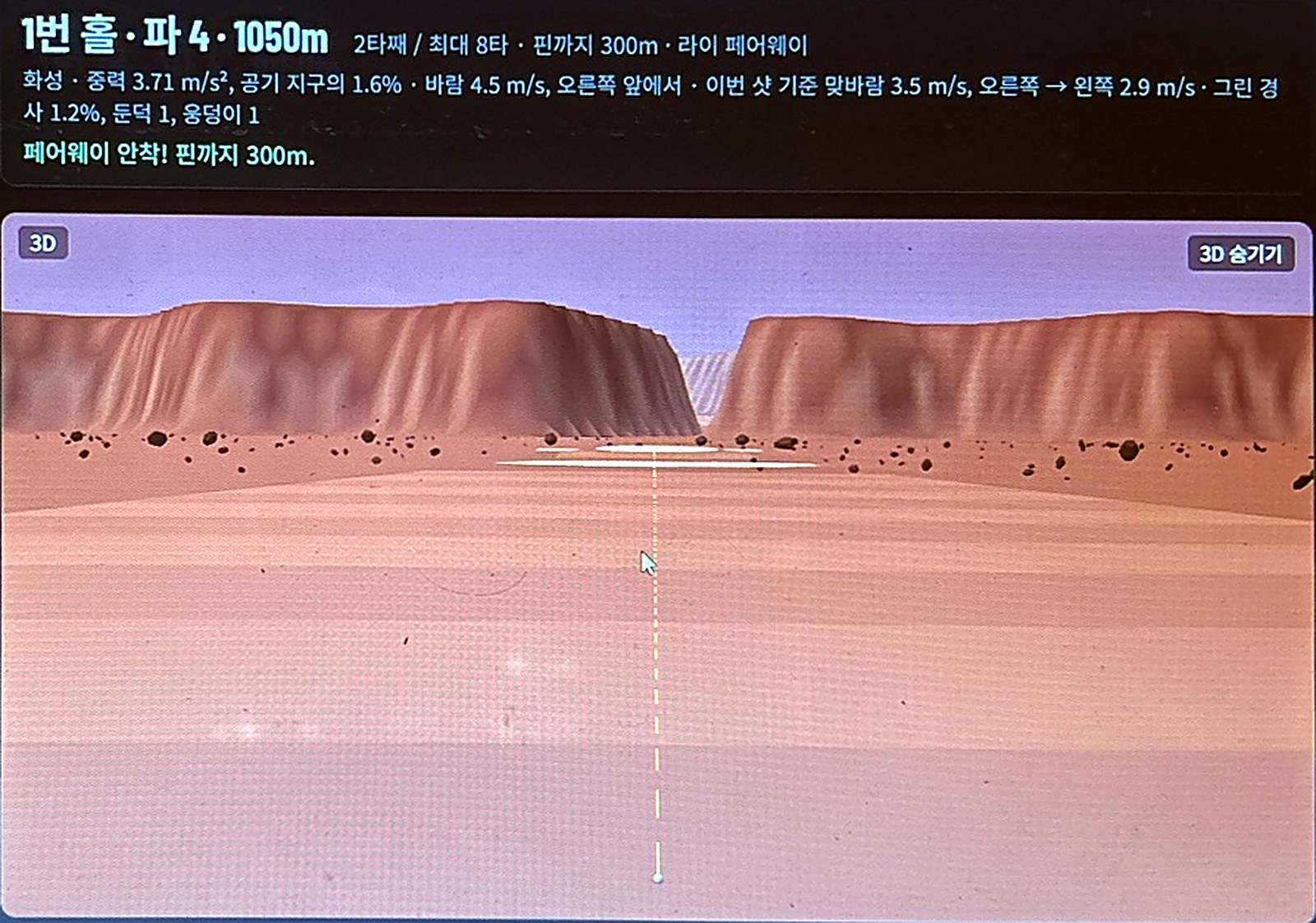
In 3D, the fairway runs between two huge canyon walls under a pink sky, with red sand and scattered dark rocks. The 2D hole map and the side-view trajectory chart also switch to red tones on Mars.
On the driving range you can pick Earth, the Moon or Mars and compare the same shot on each. The same drive carried 517 m on Mars and 1,143 m on the Moon.
I played it: from double bogey to birdie
Round one was a 6 (double bogey). Round two was a 3 (birdie). The two full shots were almost identical both times; the whole difference came from putting.
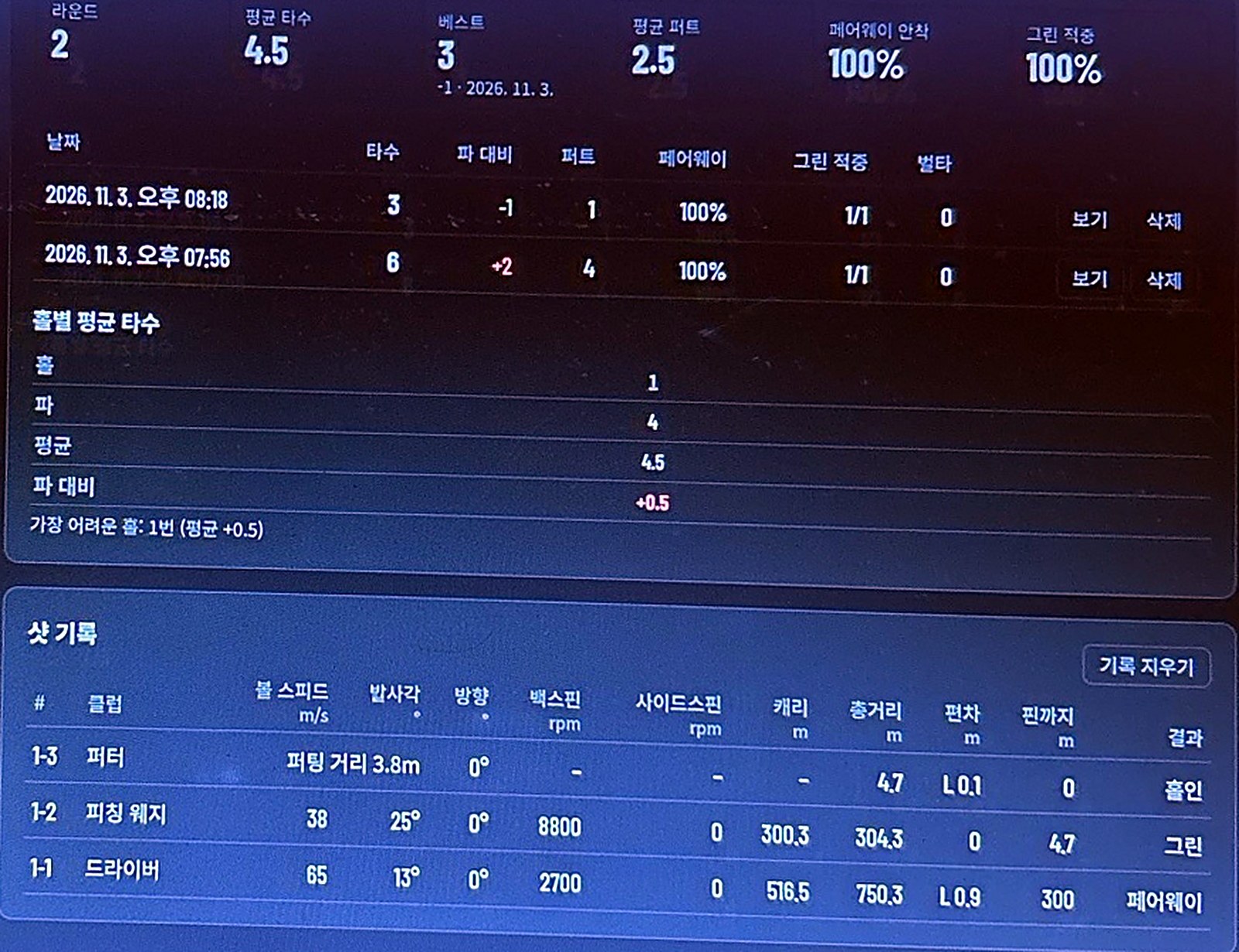
Here is the shot log from the birdie round.
| Shot | Club | Ball speed | Launch | Backspin | Carry | Total | To pin | Result |
|---|---|---|---|---|---|---|---|---|
| 1 | Driver | 65 m/s (145 mph) | 13° | 2,700 rpm | 516.5 m | 750.3 m | 300 m | Fairway |
| 2 | Pitching wedge | 38 m/s (85 mph) | 25° | 8,800 rpm | 300.3 m | 304.3 m | 4.7 m | Green |
| 3 | Putter | 3.8 m entered | – | – | – | 4.7 m | 0 m | Holed |
The drive hung in the air for 8.3 seconds, landed at 517 m and rolled more than 230 m thanks to its low spin. The wedge did the opposite: 8,800 rpm of backspin grabbed the ground and the ball rolled only about 4 m.
In round one I left myself 5 m and putted it as 1.3 m, 2.0 m, 0.6 m and 0.3 m, four putts in all. The log showed why: this green runs downhill, so the ball rolled about 1.25 times the distance I entered.
In round two I used that number, entered 3.8 m for a 4.7 m putt, and the ball rolled exactly 4.7 m into the cup. That birdie was the best proof that the physics behaves consistently.
What I fixed after playing
Playing the course turned up six things to fix, most of which I would never have noticed from screenshots alone.
| Problem | Fix |
|---|---|
| 2D hole map was Earth green | Red sand tones on Mars, with fairway, bunkers and green still distinct |
| Trajectory chart ground was green | Red on Mars |
| Top axis label overlapped the chart title | Overlapping labels are no longer drawn |
| Putter always defaulted to 5 m | Putting distance now fills in the distance to the pin (all planets) |
| Old shot numbers stayed after a new round | Result boxes reset to “-“ |
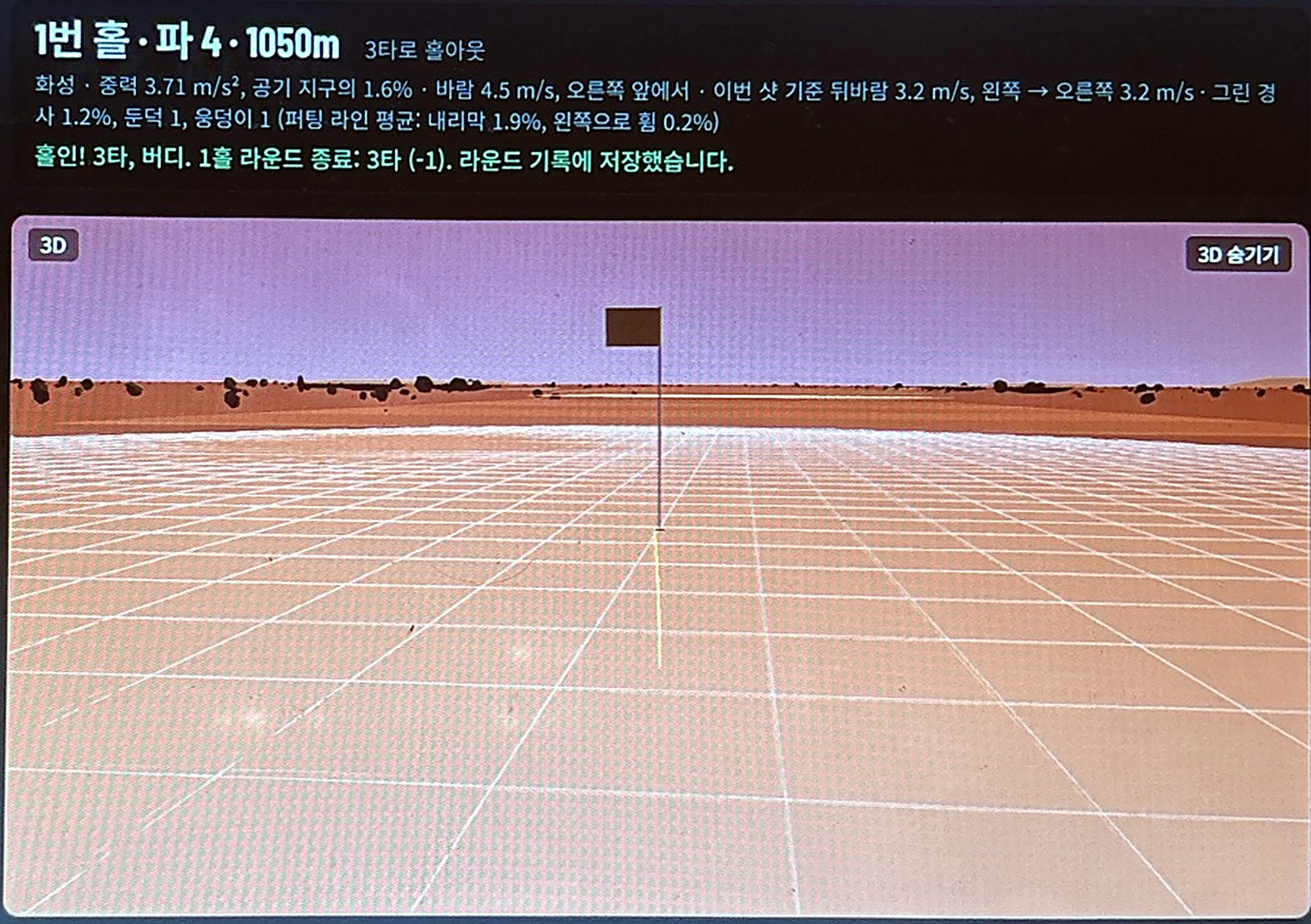
| Flag looked like a dark square in Mars lighting | Bright yellow that ignores scene lighting |
After every fix I checked that Earth and the Moon did not change. Right after adding Mars, 730 test shots on Earth and the Moon were compared with the previous version, and not a single trajectory changed.
Coming next
Next stop is Titan, Saturn’s largest moon. Gravity is weaker than on Mars and the air is much thicker than Earth’s, so it should play like the opposite of Mars.
In between, I plan to post a review of Golf+ on a VR headset. The long-term goal is to run this game in VR.
Try it yourself
The Mars course is live in your browser. Open it on a desktop or laptop and choose Mars under Planet.
Suggested shots: driver (65 m/s, 13°, 2,700 rpm), then pitching wedge (38 m/s, 25°, 8,800 rpm). If you make a birdie, let me know at hello@garagegolflab.com.