This time I built a par 3 on Titan, Saturn’s largest moon. It’s a course where a driver shot drifts backward in midair, then falls forward again. You will never see that on Earth.
In Part 4 I built a Mars course with thin air, and in Part 5 I added a caddie who talks you through every shot. Next I wanted the opposite of Mars: somewhere with very thick air. That’s Titan.
As before, I described what I wanted to Claude Code, then played it myself and fixed things as I went. I started around 10 PM and played my first round on my phone a little after 11.
What Titan is like
Titan has about one-seventh of Earth’s gravity, but its air is more than four times as dense. Here’s how I set it up in the game.
| Item | Earth | Titan |
|---|---|---|
| Gravity | 9.8 m/s² | 1.35 m/s² |
| Air density | 1× | about 4.3× |
| In-game wind | 0–7 m/s | 0–0.5 m/s |
Weak gravity lets the ball climb high. Thick air stops it fast, so it floats down slowly. Drag, lift and wind force all scale with air density, so each one is over four times stronger than on Earth.
I kept the wind very light, 0–0.5 m/s. Surface winds on Titan are known to be under about 1 m/s anyway. But the thick air means even that pushes the ball a lot: at 1 m/s a pitching wedge drifts 13–16 m. So wind is set in 0.1 m/s steps.
The driver flies backward
Running the club distances, a sand wedge carried about 31 m and a driver about 53 m. A driver that goes 200+ m on Earth beats a wedge by only about 20 m on Titan.
The fun part was the driver’s flight path:
- In 3.5 seconds the ball nearly stalls at 47.7 m.
- Until 11 seconds it drifts 5.3 m backward, to 42.4 m.
- On the way down it moves forward again and lands at 52.9 m.
The reason is backspin lift. Lift always acts at a right angle to the ball’s direction of travel. While the ball climbs almost straight up, lift points backward; as it drops almost straight down, lift points forward. On Earth the ball lands before it ever gets that vertical, so you never see it.
Changing the spin made the difference clear.
| Driver backspin | Backward drift |
|---|---|
| 1500 rpm | 0 m |
| 2000 rpm | 1.5 m |
| 3500 rpm | 7.6 m |
| 4500 rpm | 8.3 m |
More spin also means shorter carry: 75.7 m at 1500 rpm drops to 43.2 m at 4500 rpm.
A 7-iron drifts back only 0.6 m, and the wedges don’t drift back at all. Nothing rolls backward after landing; every shot rolls forward 4–7 m.
Course design: a 38 m par 3 and a methane lake
With the driver topping out around 53 m, the hole is one short par 3. It’s a length where you weigh everything from a sand wedge to a 7-iron.
| Tee | To the pin |
|---|---|
| Red | 32 m (35 yd) |
| White | 38 m (42 yd) |
| Blue | 45 m (49 yd) |
- Green: 24 m wide × 14 m deep. The ball drops nearly vertically, so it stops well front to back, but crosswind pushes it sideways, so the green is wide. There are 3 pin positions.
- Methane lake: front left of the green, played as a water hazard. Titan has lakes of liquid methane instead of water. A golf ball is denser than liquid methane, so it sinks.
- Bunkers: two dark sand dunes.
- Wind: random per hole, 0–0.5 m/s. Other planets show anything under 0.3 m/s as “Calm,” but on Titan even 0.1 m/s moves the ball about 2 m, so the threshold is 0.05.
Orange haze, fast-forward, and the caddie
The 3D view has a thick orange haze sky, brown ground and white ice boulders. A big methane lake sits beyond the green, and the bunkers are dark sand dunes. The haze blurs the distance, which gives it a properly heavy, stifling Titan feel.
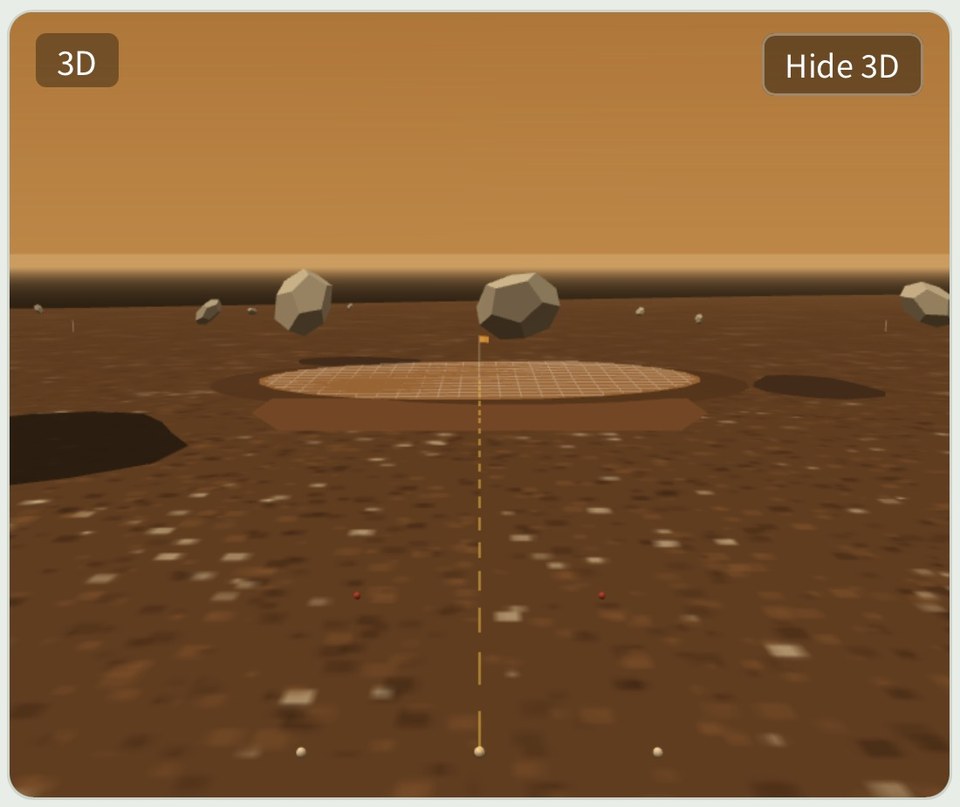
The problem was hang time. The ball stays up for 13–21 seconds, and on screen it looks almost frozen. So on Titan only, playback runs at least 4× faster: a 21-second flight finishes in about 5 seconds. Turn on “Real-time playback” to watch it at true speed. Only the display speed changes; the physics is untouched, so distances stay the same.
The caddie from Part 5 learned some Titan lines too. It used to talk only at the start of a hole and after a shot; now it also speaks when you pick a club.
- Pick the driver: “On Titan, backspin pushes the ball back for a moment in midair before it drops forward again.”
- Land in the methane lake: “That’s the methane lake. The ball sinks, so we can’t get it back. Take a one-stroke penalty and we’ll carry on.”
- On the green: “It’s downhill and breaking right, so aim a little left and just let it roll!”
The driver line alternates with another phrasing of the same idea, so it doesn’t get stale.
What I fixed after playing it
Once it was live on the site, playing it turned up five things. The math was mostly right; the problem was usually how it was shown.
| What I found | How it was fixed |
|---|---|
| The ball could pass right through ice boulders in the rough | Removed boulders from the hole; they now sit only outside OB and beyond the green |
| Wind said “from the left” but right after it said “right-to-left” | Wind text now uses the aim line of each shot; checked every 30° |
| On a 38 m hole the side view ran to 90 m, crowding the ball to the left | On Titan only, the axis now fits the hole length in 10 m steps |
| On the green the yellow flag looked like it was floating and the flagstick poked off the screen | Switched to a cloth flag; the flagstick fades when you’re on the green |
| On my phone the scoring-average-by-hole table looked empty | On 1-hole courses the table is narrower so values sit right next to the labels |
While I was at it, I redid the flags on all four planets. Same cloth, different motion on each:
- Earth: stretches out and flaps fast as the wind picks up; hangs limp when calm.
- Mars: the thin air means even a 7 m/s gale only sways it slightly while it hangs.
- Moon: no air, so it doesn’t move at all. A horizontal rod along the top holds it open, like the Apollo flags.
- Titan: white cloth that stands out in the orange haze.
The Moon flag is my favorite. The real Apollo astronauts added that horizontal rod precisely so their flags would stay unfurled on the windless Moon.
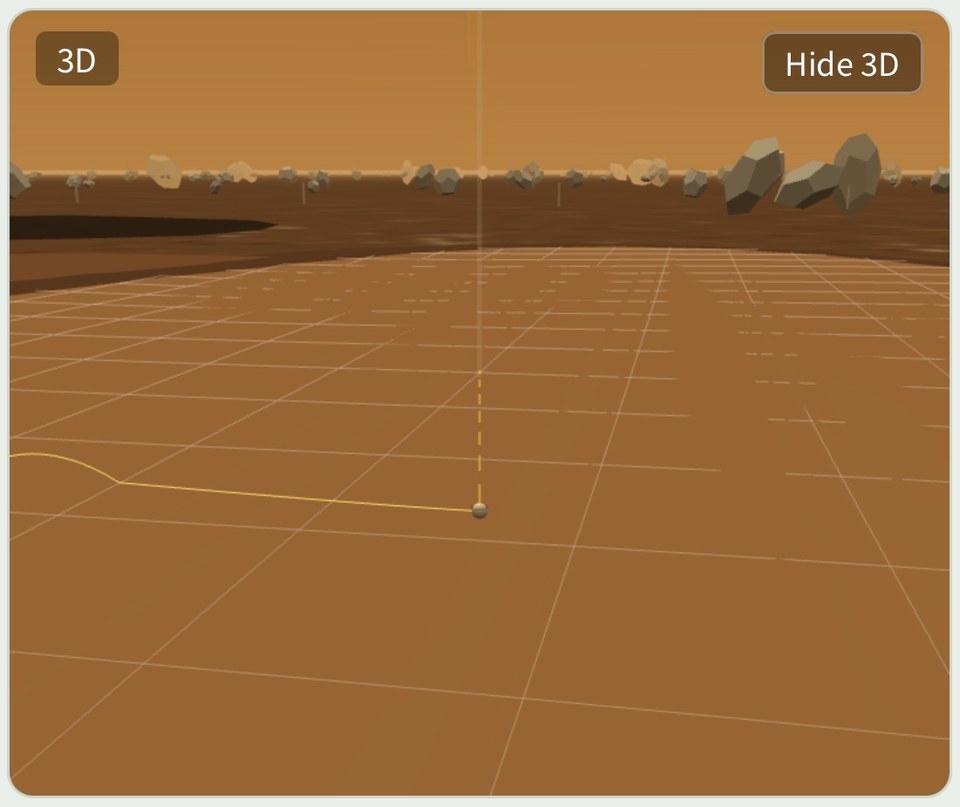
First round on Titan: 4, a bogey
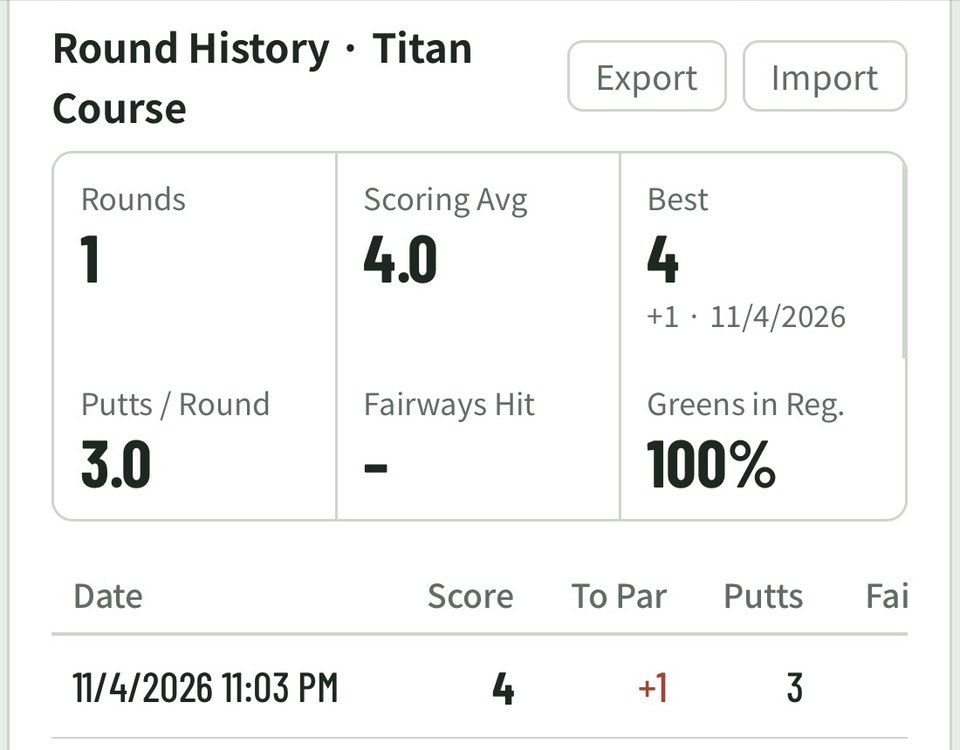
My first round, played on my phone, was a 4, one over. From the white tee (38 m) I took the caddie’s pitching wedge suggestion, with about 0.3 m/s of wind from the front left.
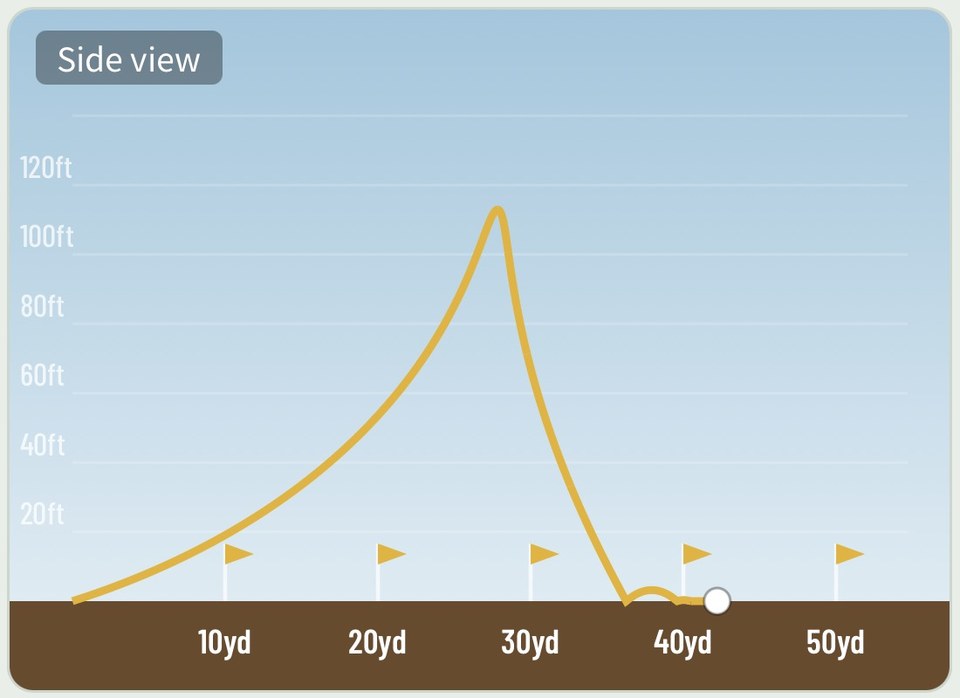
| Stat | Result |
|---|---|
| Ball speed · launch · backspin | 38 m/s (85 mph) · 25° · 8800 rpm |
| Carry / total | 36.3 yd / 42.2 yd |
| Apex | 113 ft |
| Hang time | 14.7 s |
| Descent angle | 69.5° |
| Offline | 2.9 yd right |
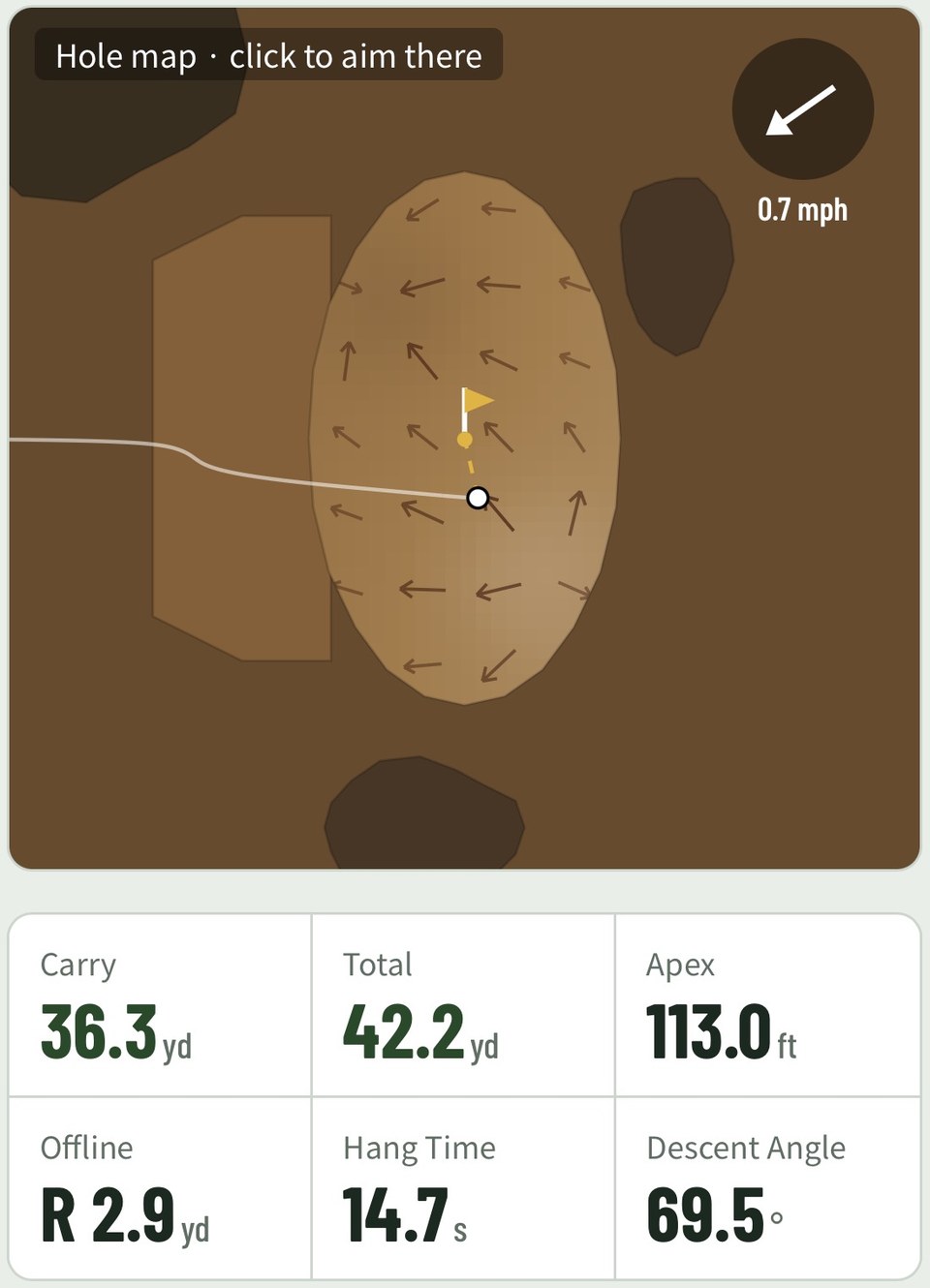
A 42-yard shot climbed 113 feet and stayed up almost 15 seconds. It finished 3 yards from the pin, and then I three-putted. Greens in regulation 100%, and the putter let me down.
You can play the Titan course at garagegolflab.com/play: just pick “Titan” as the planet. Grab the driver and watch the ball drift backward.
In the next part I plan to build another planet course. Collecting shots you could never hit on Earth is turning out to be a lot of fun.